Polyurethane innovation, engineered customer-by-customer. Roots to 1937, founded 1965.
MCPU was founded by chemists who refused to tell customers their problem was unsolvable. Three generations later, that's still the only thing we do.
Our story
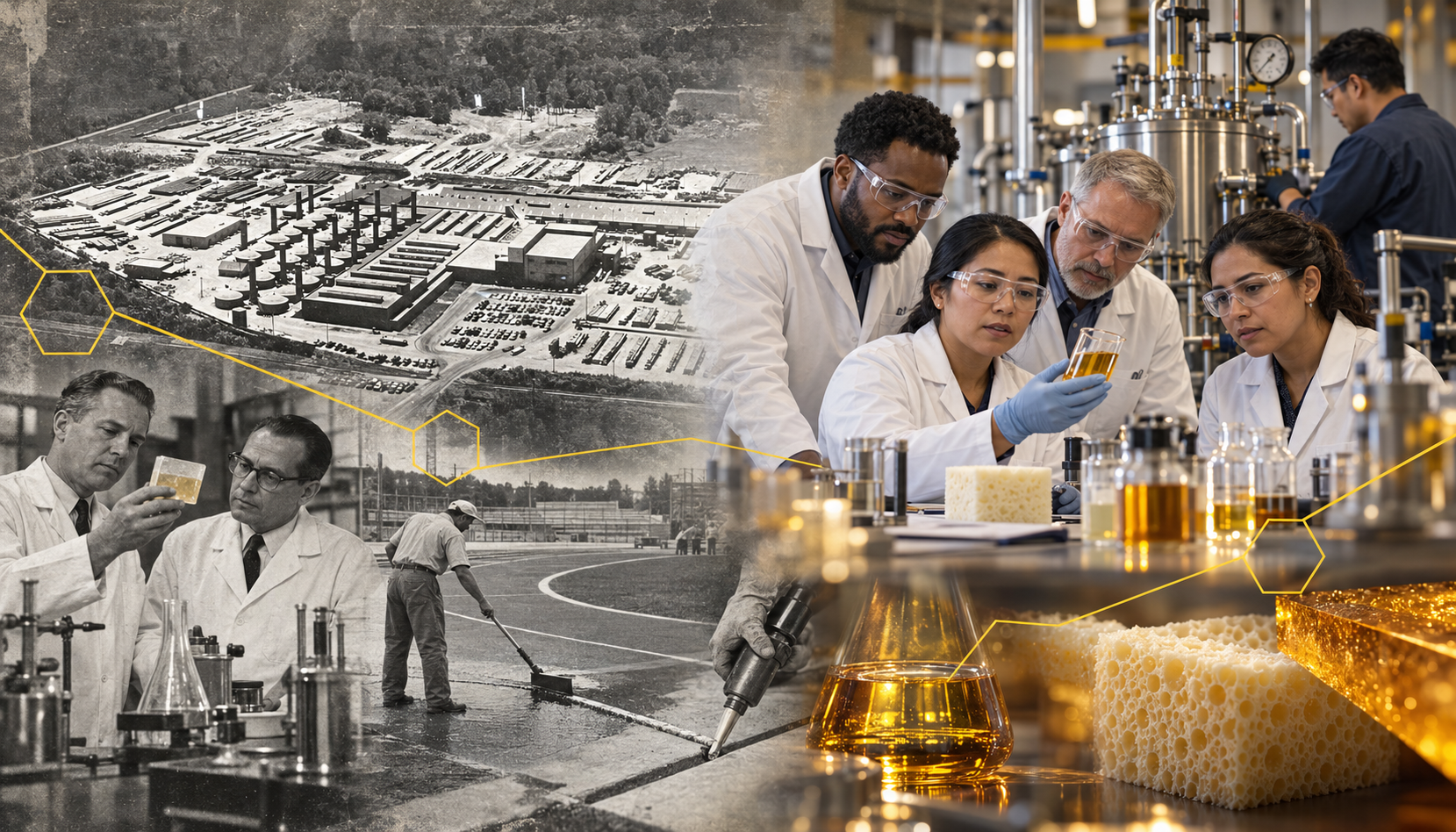
MCPU’s research lineage traces back to 1937, and MCPU Polymer Engineering itself was founded in 1965 to commercialize polyurethane chemistry that the major chemical companies considered uneconomical. The first products were specialty sealants and athletic-track binders. Both remain in production today.
Across five decades the playbook has not changed: a customer brings a hard formulation problem, an MCPU chemist runs at it. The catalog grows by addition — every product on it started as somebody’s impossible spec.
What we believe
- Chemistry is a service. A drum of polyol means nothing without the formulator who knows how to use it.
- Customer scale doesn’t set the conversation. Pilot-batch buyers get the same chemists as Fortune-500 OEMs.
- Halogen-free, low-carbon, low-VOC. Not because of marketing — because the spec sheet is moving that way and we’d rather lead than catch up.
- U.S. manufacturing. Redundant supply, rapid iteration, no ocean-freight surprises.
Innovation timeline
MCPU begins as the research arm of the W.S. Dickey Clay Company with the hiring of chemistry professor Elmer R. Ligon.
MCPU has been manufacturing polyurethanes since the late 1950s, and biobased reactive additives for over 20 years.
MCPU opens with a single mission: solve PU formulation problems that other suppliers walked away from.
The first polyurethane athletic running surfaces came from MCPU chemistry — invented for the Olympics and still in use globally.
A novel one-part PU sealant for municipal sewer joints — engineered for moisture-cure performance underground.
A fluid-applied polyurethane roof restoration system, CRRC-registered, that restores commercial roofs instead of replacing them.
Reactive primary-OH soy polyols arrive — bio-content without the resilience trade-offs of natural-oil polyol blends.
Halogen-free TCPP replacement for PIR boardstock — engineered ahead of the regulatory phase-out.
More than 350 million pounds of polyurethane produced to date. Lab and manufacturing in Pittsburg, KS with an administrative office in Corona, CA — full-scale production, pilot-lab capability, and a chemistry roadmap focused on bio-content, halogen-free FRs, and low-carbon PU.
Certifications & memberships
- USDA BioPreferred — Honey Bee® polyols
- CertiPUR-US compatible chemistries for flexible foam
- American Chemistry Council — Center for the Polyurethanes Industry (CPI)
- Spray Polyurethane Foam Alliance (SPFA)
Explore About MCPU
Our Story
Roots to 1937, founded 1965: MCPU formulates novel polyurethane chemistry — Tartan track binders, Honey Bee polyols, Yellow Jacket FR.
Scientists & Technical Team
MCPU's polyurethane chemists formulate, test and scale customer systems directly — bench work, pilot trials and plant support from the same team.
Patents & Research
MCPU's patent portfolio and ongoing research in biocongruent chemistry, halogen-free flame retardancy and reactive renewable polyols.
Manufacturing & Quality
U.S. polyurethane manufacturing in Pittsburg, Kansas: pilot lab, full-scale reactors, toll blending, lot testing and certificates of analysis.
Locations
MCPU Polymer Engineering: lab and manufacturing in Pittsburg, Kansas, with an administrative office in Corona, California.
Start with a non-confidential summary. We'll take it from there.
Tell us the performance target in non-confidential terms. If it is a fit we put an NDA in place, review your existing formulation and specification, then move to bench development, testing, customer trial and scale-up.