
Biocongruent Chemistry™
A design strategy for polymers whose formation, function, degradation and reintegration are congruent with biological and ecological cycles — without giving up the service life or the economics of a conventional fossil-based system.
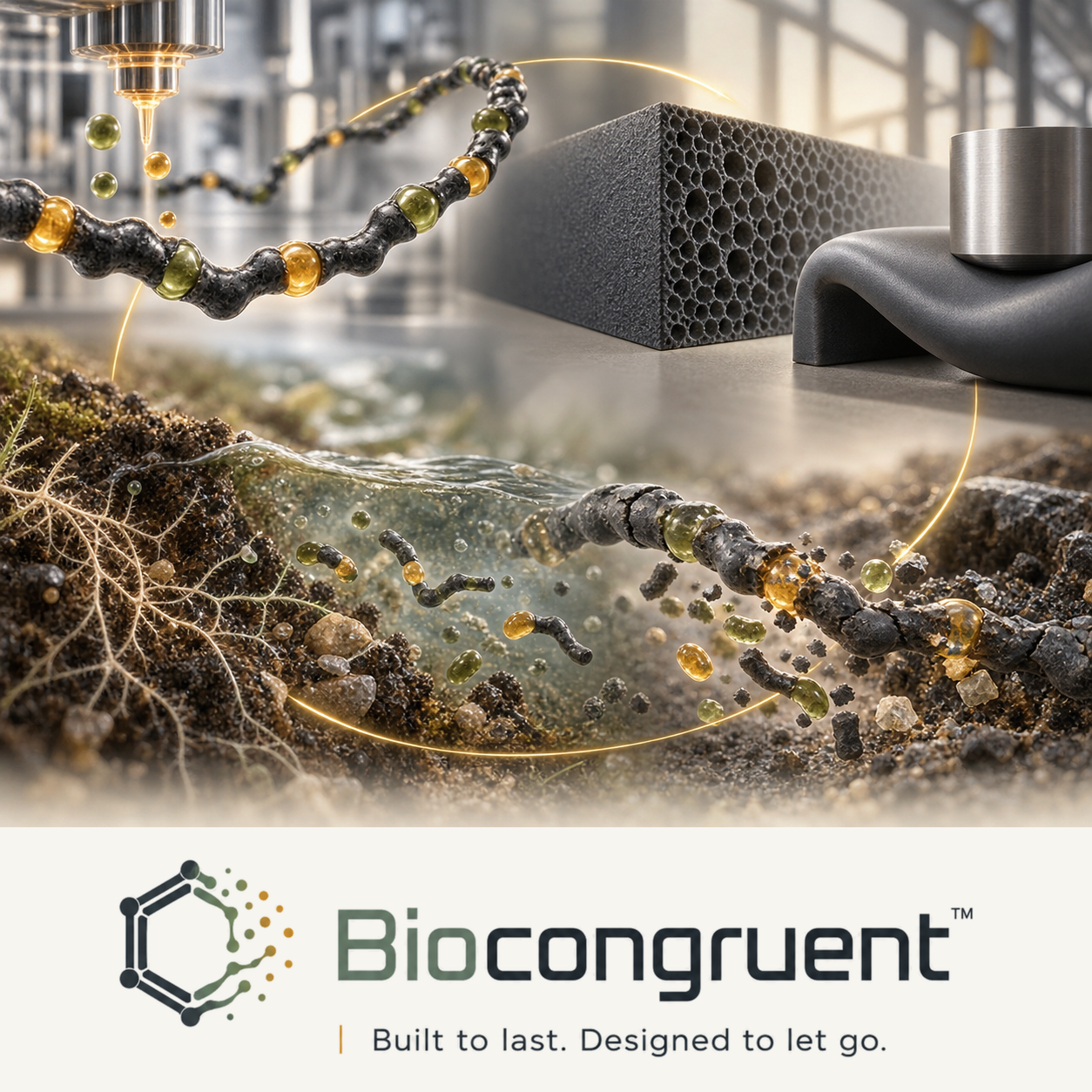
Biocongruent chemistry is the design of synthetic materials whose formation, function, degradation and reintegration are congruent with natural biogeochemical cycling. Biocongruent materials carry environmentally accessible molecular motifs that permit eventual reintegration into natural cycles while maintaining a useful service life.
Most durable polymers earn their performance through bioorthogonal molecular architectures — structures biology simply does not recognise. That same design choice is what makes them persist. Biocongruent chemistry decouples the two: keep the proven backbone, introduce a biologically accessible unit at additive levels, and tune placement and concentration so performance holds while end-of-life behaviour improves.
Three criteria a sustainable material has to meet
Safe
- Non-toxic materials and processes
- Low CO₂ emissions
- Regulatory compliance and risk reduction
Circular
- Renewable or recycled inputs
- Durability in service, degradation at end-of-life
- Biocongruent pathways into natural cycles
Economic
- Competitive cost and performance
- Scalable, efficient manufacturing
- Creates business value and supports growth
Biocongruent chemistry in the news
Biocongruent chemistry in Pittsburg
Local TV coverage of MCPU Polymer Engineering's Biocongruent Chemistry™ work at its Pittsburg, Kansas facility.
Watch on YouTubeExplore the framework
What biocongruent chemistry is — and what it is not.
A definition, the three sustainability criteria it has to satisfy, and the misconceptions it exists to correct.
Keep the backbone. Add the biocongruent unit. Tune, don’t trade off.
The A-B-C design strategy, the additive chemistries behind it, and why placement and concentration matter more than percentage biobased content.
Durability in service. Accessibility at end-of-life.
Why the two are separable properties, and why landfill behaviour — not the recycling ideal — is the honest yardstick for most polymers.
The data behind the framework.
Physical properties, flame performance, soil-burial and wastewater degradation, and a cradle-to-grave life cycle comparison — as reported at CPI 2026.
Where biocongruent chemistry has been demonstrated.
Rigid insulation foam, viscoelastic foam, non-cellular elastomers and silicone composites — four systems where the additives were run against conventional controls.
Technical insights for formulators.
Why co-polymers fail at their weakest link, why additive placement beats additive percentage, and where current life cycle methods run out of road.
Talk to the chemists who ran these studies.
Send us your system and target properties — we'll tell you where a biocongruent additive fits and what to expect from it.